
Plotting, Messy Drafts, & Learning How to Write
Outlines, pantsing, revising, and learning that there are many ways to write a book.

I used to have this fanciful, idealistic notion that writing a book was a magical experience, where the writer was a conduit, putting words on the page and following hypothetical muses to the end of the story without a plan. I also used to believe there was a department store in my closet that my cats could access only at midnight on Christmas Eve. I was wrong on both fronts.
Writing my first novel was a learning experience in a multitude of ways, including learning how I write.
To pants or plot
With my first real attempt at writing a novel, I got stuck with the plot about three-quarters of the way through and abandoned ship. When I started writing my current project (which landed me my literary agent), I was determined not to repeat past mistakes; this time, I intended to outline the hell out of it.
And I did. I mapped out my central conflict, sketched out my main character’s personality, planned out what was going to happen chapter by chapter. Then I got stuck halfway and stared miserably at the outline for months, but couldn’t figure out how to get to the end. Joy.
Eventually, I chucked my initial outline aside and wrote the second half of the story without a plan. I started with a random fun scene that I enjoyed writing and rode the wave to the end. Afterward, I went back and reverse-engineered my outline to reflect the ideas I’d come up with. And that’s how I learned I’m a discovery writer, somewhere between a pantser and a plotter. I need some kind of plan, but if I get stuck, I need to be free to just write and see what happens. The outline is a vague map, not a cage, and it can always be modified.
Fyi I found Ellen Brock’s series on her four types of novel writers really interesting. If I remember right, I’m what she describes as a methodical pantser.
How I reverse-engineered the outline
When I migrated my million scattered files into Scrivener, I added a very short summary of each scene to the corkboard view so I could see everything at a glance. In the outline view, you can see everything in a linear order, see keywords you’ve added, settings, etc. I exported the outline view into an Excel worksheet that I printed and never looked at again.
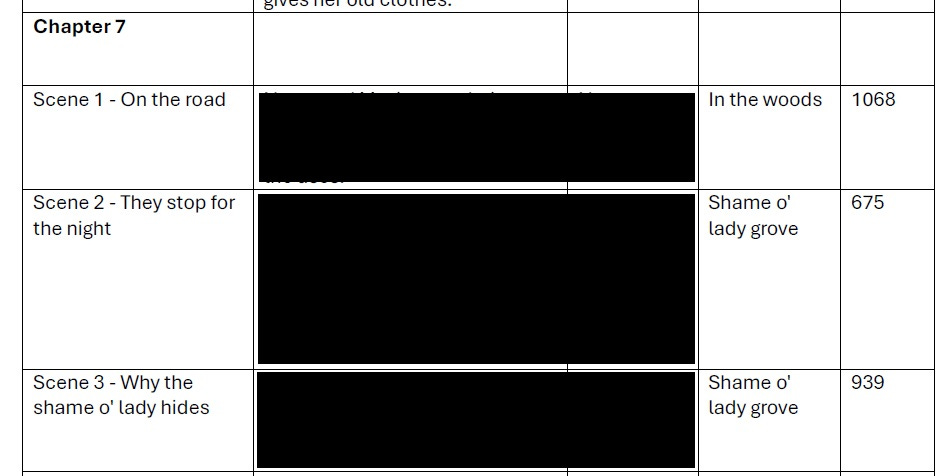
I copied and pasted the information into a Word doc because something in my soul hates seeing things in Excel. I used the three-act structure and the Save the Cat beats to organise my chapters and scenes in a more fleshed-out outline.
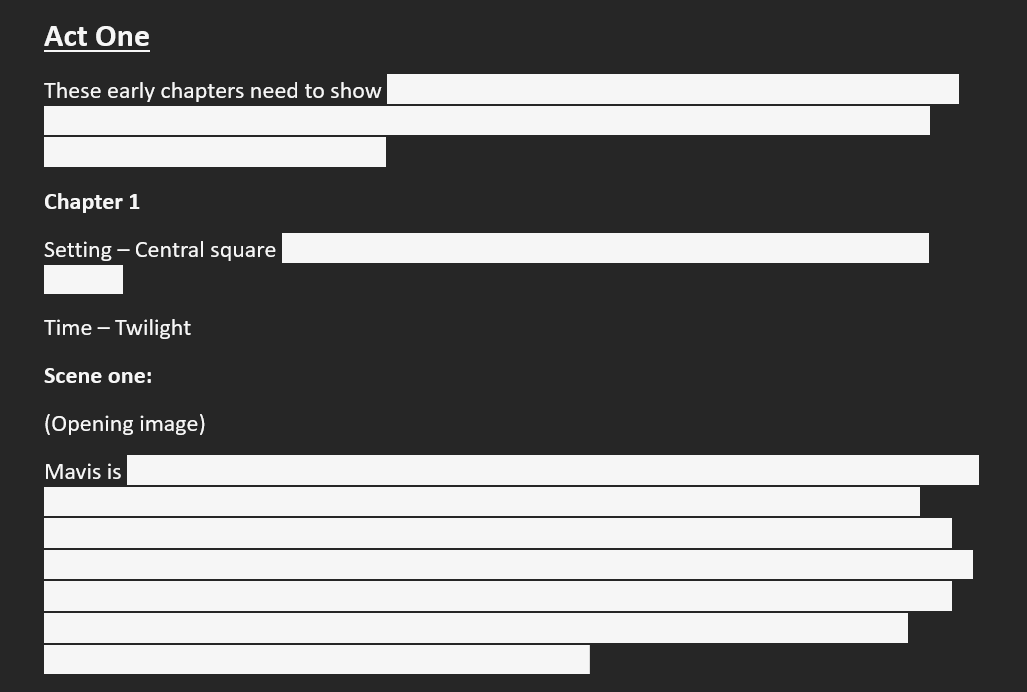
I actually didn’t even remember I made this outline until I started writing this. By that point in the process, I remembered what needed to go where. The outline (outlines?) was always there if I needed it.
Does this sound messy? It was messy. I am a mess.
Revision
I wrote the thing, I organised the thing with my reverse-engineered outline, I read over the thing. Hot mess. But that’s what revision is for!
I read through and made notes chapter by chapter. Then I looked at all those notes and wanted to cry because, good lord how was I going to fix all of that?
By tackling the big structural issues first with a developmental edit.
I made notes on the story as a whole, what I thought worked, what didn’t, what needed more explanation, and what needed to be cut or added. All my notes are longhand in a physical notebook. For some reason the act of handwriting helps me crystalise things in my brain in a way typing doesn’t. I went through my chapter-by-chapter notes and drew up a revision plan for each one, keeping the question, ‘What does this chapter need to accomplish?’ at the forefront of my thoughts.
For example:
Chapter 15 (total re-write)
What does this chapter need to accomplish/set up for the rest of the story?
Leading up to this chapter the main character knows:
1. X
2. Y
3. Z
She needs to know:
1. A
2. B
3. C
While the developmental stage is focused on big-picture issues, I couldn’t help but line-edit a bit as I went, though I allowed myself to shrug and say, ‘Well, that sentence feels wrong but I dunno how to fix it, so I’ll come back to it later’.
When I felt that the story was relatively settled in its structure, I went in and got nitpicky with individual words, looked for stronger verbs, better imagery, and battered the prose into better shape.
While I organised my novel in Scrivener, I’d copy scenes into Word to edit them (don’t ask me why). I found the Read Aloud feature really useful. You’re better able to catch awkward sentences and other mistakes when you hear them out loud.
Getting stuck
When I got stuck, which happened a lot, a few things helped:
Writing bullet points of what’s supposed to happen in a scene.
What the setting is and a loose description (it’s a muddy stream)
What emotions the character/characters are feeling (sadness)
What dialogue should happen (they talk about the stream, it’s a funny conversation)
Any foreshadowing that could happen.
What the action is (the main character runs across the stream)
What consequence does that action have (she gets muddy)
Writing like a play.
I’d write the dialogue with some stage directions.
MC [waves]: Hi
Other Character [closes eyes]: Not you again.
Other Character walks to the back of the room and sits down angrily.
Then I could fill in the flesh and blood of the scene around these bones at another time.
Physically arranging a scene with index cards.
Doing anything that’s not writing. 🤸♀️And trying not to feel guilty about it.
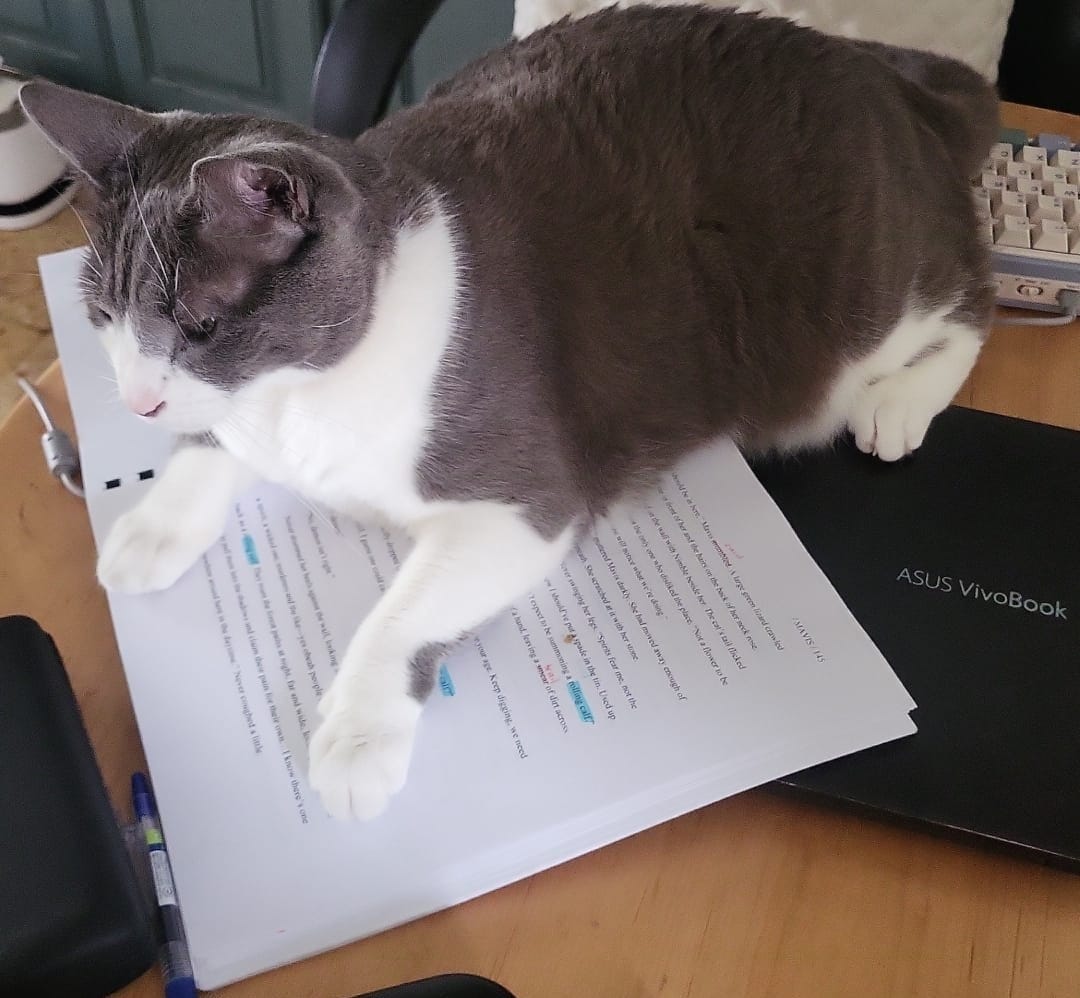
⏲️☕Pomodoro method & establishing routines
I find the different ways authors work fascinating. I remember reading an old Reddit AMA with Naomi Novik where she talked about her daily process:
“My process changes from project to project. What I'm always trying to do is get into a state of flow, and what often works best for me is to give my brain a bit of a challenge by having a new "trick". I've done wordcount targets, I've done going to a cafe with laptop, I've done pomodoro method, I've done writing longhand, etc.”
The Pomodoro method was really helpful for my easily distracted, procrastination-loving brain. I used a focus timer to break up my overall writing time goal into 30-minute chunks with 5-minute breaks, which felt far more manageable than trying to bully myself to sit down for three hours. This was all more complicated while I was working full-time, and I wrote a lot less, but once I was made redundant, I went all in and set a goal of five hours per day, Monday to Friday, three hours in the morning, two in the evening (I definitely did not always meet this goal).
Writing every day is a struggle for me, and I found that having the weekends off, or writing every other day when I was working, helped me sustain my workflow better over time. To all those who write every single day, I take my hat off, but it doesn’t work for me.
Not having a set workspace is a challenge. Some days I’d sit at my small living room table. Some days I’d move the table into my bedroom. Other times I’d work on the couch or in bed with a tray table on my lap. But the one constant is hot beverages and snacks. I’m not a tea-drinker except while writing; something about the routine of making a mug of milky, sweet tea says to my brain it’s time to do something productive.
Some days are not going to be productive. Breaks are important! I still have a hard time not feeling bad about taking them.
And that’s it for now. I’ll be going on submission to publishers sometime soon *cue massive anxiety* and I’ll share more about what that hellscape is like when I get there.
There’s no one correct way to write a book! We all have to find our own path to get the words down and then improve them. Try not to take prescriptivist advice like ‘you have to write every day’ to heart. Figure out what works for you.
I hope this helped you feel more sane about your own writing process, no matter how messy it might be.
Thank you for sharing. I love how similar our writing process is! I also started my first draft with an outline which I quickly abandoned; outlined more, which I abandoned too. Then when it came to rewriting I had to reverse engineer the outline and do up the notes for each scene. I still have whole chapters which are under/around 1,000 words help. 😶
It's been nearly a month since you published this one and I still think about it often. Processes, pantsing, pomodoro; I love learning more about what works for different minds!